New!!!
We are very excited to announce that Makiko Tada will be in Coupeville Washington for two three day workshops March 10th through 15th!! Please click here for all the information.
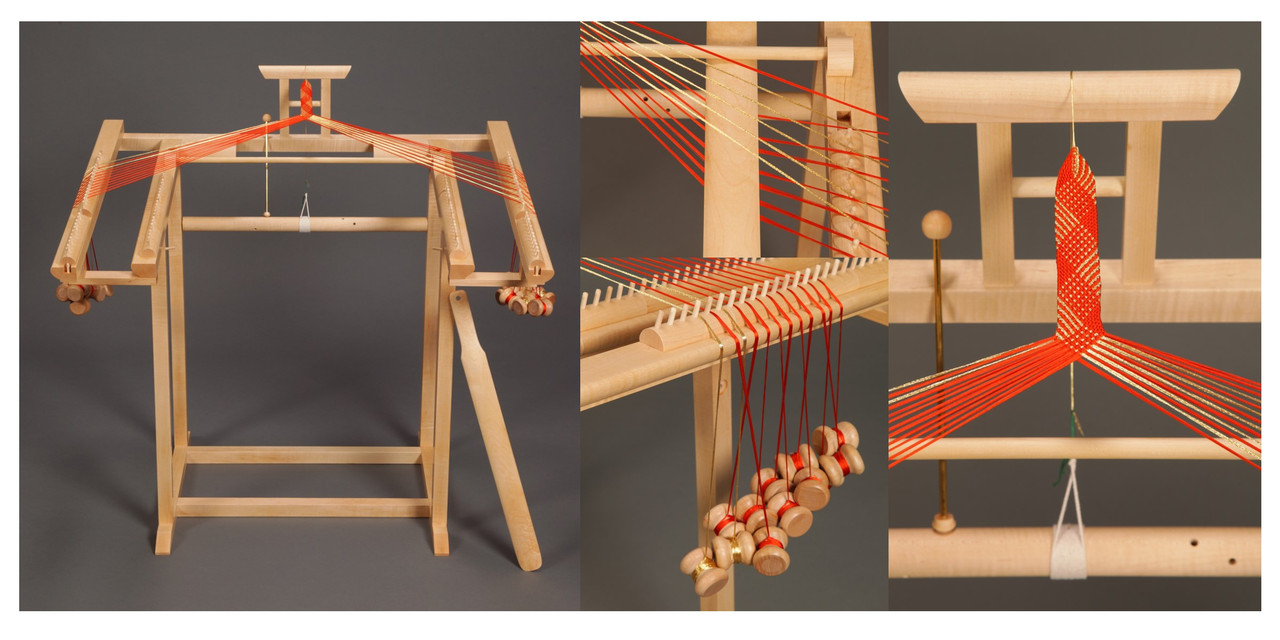
BraidersHand's new karakumidai comes in two heights and breaks down to fit into your suitcase for travel!
Our larger sized tama and heavier tama are here, now you can get larger tama to hold more thread or yarn and heavier tama for karakumidai or other applications. We hope to have a kakudai next year (we have been saying that for a few years but 2009 looks like the one!).
We will also be offering our Chinese Braiding Loom as described in Chinese Braid Embroidery by Jacqui Carey.
Our Bamboo yarn is here! Click on the Shade card under Bamboo Yarn in the third column.
We are very pleased to offer cylindrical end caps from Japan. These are the same beautiful end caps that many of you have seen on Makiko Tada's jewelry.
We carry the double-eyed Bodkin that is mentioned in Making Kumihimo by Rodrick Owen. The tool is used for starting takadai braids with a straight end rather than a point. This method could be used for other types of flat braids as well.
Looking for kumihimo instruction? Click workshops for a listing.
Visit out our Tips page!
Our equipment is built in our workshop in Washington to Rodrick Owen's specifications.
How to Order
We have no shopping cart as we like to talk to you and answer your questions. Please click for details. You can also send an e-mail or call us at 360-678-4788, Toll Free 866-821-4613, we are in the Pacific Time Zone.
Saunders Solutions Inc. DBA BraidersHand.
January 3, 2009
Site content © 1996-2009 by Janis Saunders. · All rights reserved.
Page offered by sandiego.com
| Kumi (to plait) + Himo (string or cord) = Kumihimo, plaited cords, braids
Kara (Chinese) + Kumi (braid) + Dai (a stand) = Karakumidai, Chinese braid stand
Taka (high) + Dai (a stand) = Takadai, high braiding stand
Maru (round) + Dai (a stand) = Marudai, round braiding stand
Ayatake (wooden) + dai (a stand) = Ayatakedai, wooden stand
Tama = bobbins
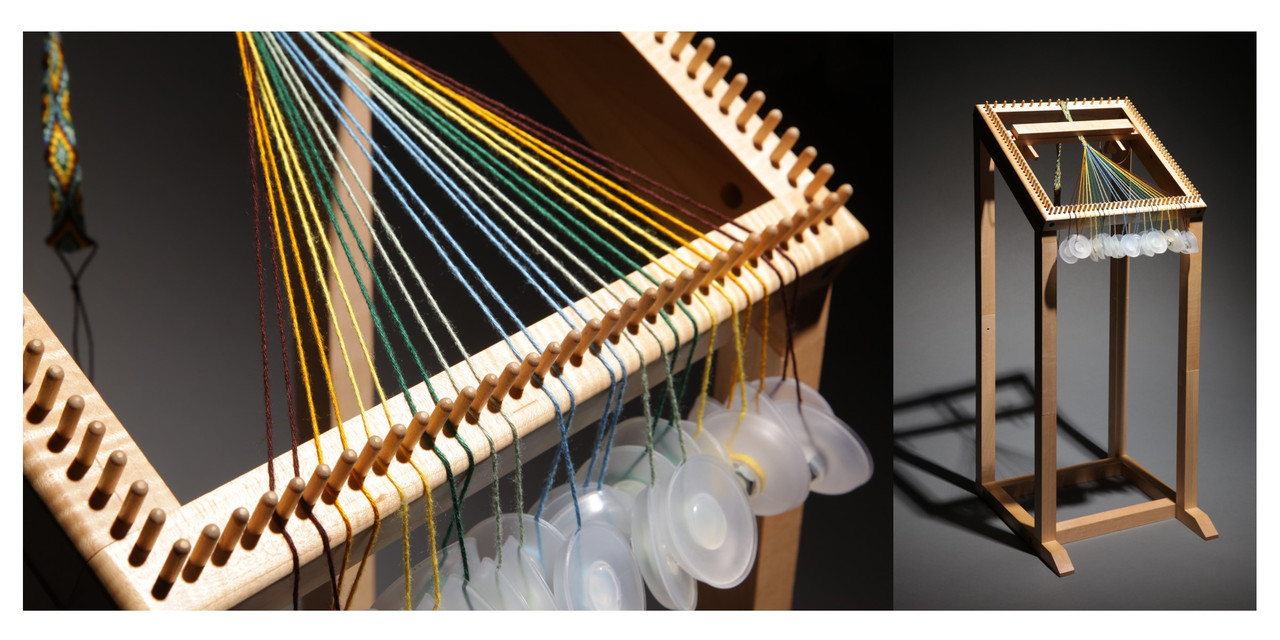
Kumihimo Disk and Plate = a dense foam tool for beginners and a quick sampling tool for experienced braiders
Kumihimo is pronounced, koo-me-he-mo.
Karakumidai
The karakumidai is a small braiding stand produces twined braids made up of diamond and half diamond shapes. Braiders find it fascinating to watch the colorful diamond shapes take form as the braid grows.
Takadai
The takadai makes obliquely interlaced woven braids up to several inches wide. One layer braids, two layers joined at edges (double-face), and pick-up braids may be made on this stand. This page also features our swords and raddle.
Tama
Tama are made of wood, lead filled with both ends sealed; they come in 35, 70, 85, 100, and 240 gram weights.
Marudai
The Marudai makes a round, square, hollow, or flat braid. We offer two diameter mirrors (tops), 25cm (10") and 30cm (12").
Counter Weight Bags and Instruction for braiding drawstrings.
Ayatakedai and Ayatakadai
The ayatakedai makes warp twined bands similar to tablet weaving. If you already own a Braidershand takadai you can add an ayatakedai unit to the front of your takadai, then the whole thing is called an ayatakadai.
Publications
A select group of braiding publications from around the world; monographs, books, video, DVD and software for braiders.
Kumihimo Disk and Plate
Disks, Plates, Kits and Books for both!
EZ Bobs
We carry both small and medium EZ Bobs, these little bobbins can be used for many things especially for the Kumihimo Disk and Plate
Japanese Threads, Bamboo Yarn and Ribbon
We carry two lines of Japanese kumihimo silk, 120 colors. Our synthetic thread, Imposter, has 67 colors and we have 15 metallic colors. Check out our Bamboo yarn and hand painted ribbon too!
Jewelry Findings
Turn your braids into necklaces and bracelets with our gold and silver end caps from Japan for round braids and our crimps for flat braids..
Warping Pegs
Warping Pegs make measuring out braiding warps very simple.
Kumihimo Gallery A few images of takadai braids and images from the Kumihimo Exhibit and Workshop in San Francisco in April 2002.
This link is to weavershand where you can click on Kumihimo to learn more about Japanese braiding.
|