
Making Kumihimo,
Japanese Interlaced Braids
by Rodrick Owen
This title is out of print. BraidersHand occasionally acquires used copies, which will be offered for sale when available. You may also find copies at your local library.
Originally published in 1989, this book remains an important English-language reference on takadai braiding. It begins with setting up the takadai and introduces the fundamentals of plain weave before progressing to twill, rep weave, double braids, and double pick-up braids. The book also includes information on materials and equipment, a gallery of finished braids, and a photocopiable appendix containing charts and instructions.
Language: English • Hardcover • 192 pages • Full color
Known Errata and Corrections
Errata - Page 1 (pdf)
Errata - Page 2
Page 77, Design 17
On Graphs 2 and 4, the total number of tama at the top is listed as 21. It should be 24.
Page 95, Design 27
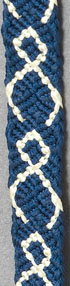
If you repeat the final two moves three times, as written, the contrasting color will end up in the middle position on the tama. This produces the braid shown in the photograph.
To produce the symmetrical braid shown in Figure A, repeat the final two moves five times, not three. This returns the contrasting color to the top position on the tama.
Tim Clark has not tested Figures B or C, although he believes the same correction likely applies to Figure B. He cannot confirm whether it applies to Figure C.
Pages 163–167 and 165
If you plan to make any of the double-faced braids, please note that the Takatool templates printed at the back of the book are not reproduced at the correct scale.
As Tim Clark discovered, the master templates on page 165 are slightly smaller than the twill graphs on pages 163, 164, 166, and 167. If you trace the templates directly from page 165, the resulting Takatools will not fit the graphs properly.
Instead, print one of the graph pages at full size, place a sheet of translucent plastic over it (Tim used a flexible plastic cutting board), and cut the Takatool to match the printed graph.
Our thanks to Tim Clark for discovering and sharing these corrections.
